Planktonium Live is a voyage of discovery to a secret universe, a live performance with the smallest organisms playing the leading role. For Shaping Bonds Dutch photographer and filmmaker Jan van IJken collaborates with composer and clarinetist Jaime Peña whose work explores the poetic potential of everyday sound. Together they create a total experience that immerses the audience in the images and sounds of an underwater world that goes beyond the natural boundaries of our senses.
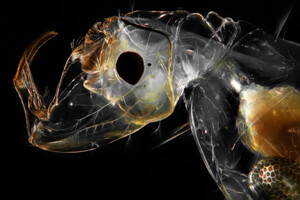
Microscopic images of various species of plankton show an assortment of rotating, crawling, spinning and dancing objects, in all shapes and sizes. Are they molluscs emitting light signals, or are they spaceships, gemstones, human cells? Their beauty appears extraterrestrial, but they are vital to our planet: plankton produces half of all the oxygen on Earth, absorbs large quantities of CO2 and forms the beginning of the food chain. It is now threatened by rising temperatures and ocean acidification.
Hert Documentaire Paviljoen / De Spiegel, Vondelpark Amsterdam
Planktonium – Short film and photo series about the unseen world of living microscopic plankton
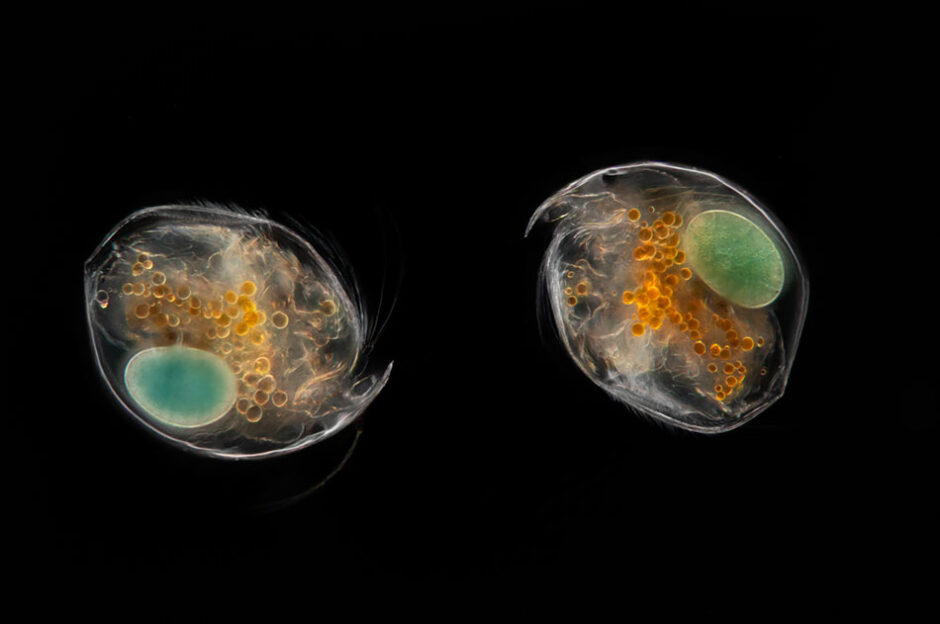
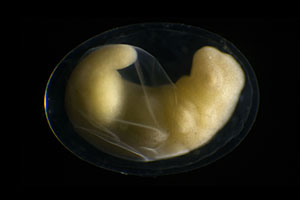
Developing egg of the tunicate Ciona
Photo Jan van IJken
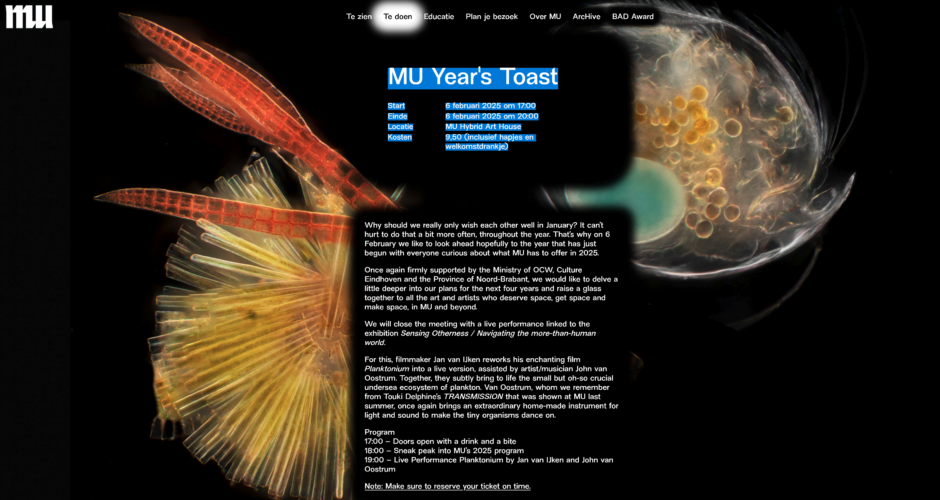
Why should we really only wish each other well in January? It can’t hurt to do that a bit more often, throughout the year. That’s why on 6 February we like to look ahead hopefully to the year that has just begun with everyone curious about what MU has to offer in 2025.
Once again firmly supported by the Ministry of OCW, Culture Eindhoven and the Province of Noord-Brabant, we would like to delve a little deeper into our plans for the next four years and raise a glass together to all the art and artists who deserve space, get space and make space, in MU and beyond.
We will close the meeting with a live performance linked to the exhibition Sensing Otherness / Navigating the more-than-human world.
For this, filmmaker Jan van IJken reworks his enchanting film Planktonium into a live version, assisted by artist/musician John van Oostrum. Together, they subtly bring to life the small but oh-so crucial undersea ecosystem of plankton. Van Oostrum, whom we remember from Touki Delphine’s TRANSMISSION that was shown at MU last summer, once again brings an extraordinary home-made instrument for light and sound to make the tiny organisms dance on.
Program 17:00 – Doors open with a drink and a bite 18:00 – Sneak peak into MU’s 2025 program 19:00 – Live Performance Planktonium by Jan van IJken and John van Oostrum
During the Art Route 2024, live performances by visual artist Jan van IJken and musician/installation maker John van Oostrum (Veenfabriek, ToukiDelphine) will take place in Museum De Lakenhal in Leiden.
The microscopic images of plankton (with lots of new footage) will be projected live by Van IJken and accompanied by sounds from the installation ‘Glass, water, light’ by Van Oostrum, who will also play guitar.
The performances will take place in the auditorium of the museum on Saturday 21 September and Sunday 22 September at 3:30 PM. Admission is free and reservations are not required, but full is full, so be on time. The performance lasts more than half an hour.
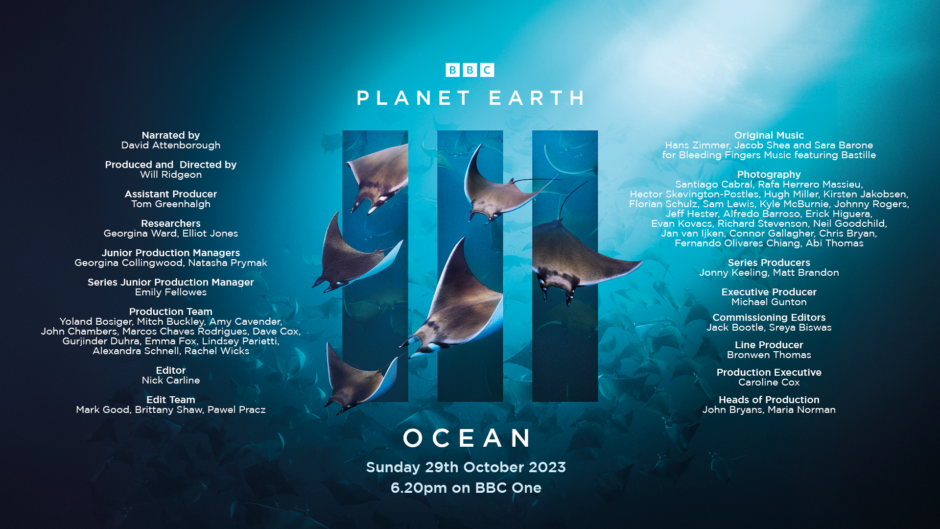
A short 1 minute sequence of my plankton footage has been screened in the Ocean episode of BBC Planet Earth III. The series is narrated by Sir David Attenborough and I feel very thankful and honoured to be part of this groundbreaking series! Many thanks to producer / director Will Ridgeon and his team.
Our home – thrilling, mind-blowing, and full of hope. David Attenborough shares amazing stories of the wonders of the planet. There’s always more to discover.
The ocean covers two thirds of the planet and is home to 80% of all animal life, yet much of it remains unexplored. In this episode, we join David Attenborough on a journey through the vast and changing ocean to reveal the extraordinary behaviours and remarkable adaptations required for life to survive here.
For life beneath the surface, the ocean can be a battlefield. In the shallow seas of the tropics a lionfish is fatally ensnared by a shrimp-like lure, seductively dangled from the head of a cunning clown frogfish. In the giant kelp forests off North America, a young horn shark is ambushed and swallowed whole by an angel shark – which may have bitten off more than it can chew – and out in the empty big blue, flying fish search for floating seaweed to lay their eggs but end up attracting the attention of hungry blue sharks.
Today, islands of seaweed are being replaced by plastic – every year 12 million tons of it ends up in the ocean. It is lethal to many (and the crew had to rescue many entangled turtles while filming), but Columbus crabs are making a home on these unnatural rafts. The crabs, however, are poor swimmers, so to find a mate, they must hitch a lift. Passing turtles can help and in fact provide a permanent home for a pair of crabs – in return the crabs provide an onboard grooming service. The relationship that works so well, these turtles are often joined by a pair of crabs. Finding a partner in the ocean is not always this easy. In the Sea of Cortez, mobula rays perform astounding, acrobatic leaps that appear to attract other rays – but the performance also attracts a family of specialist ray-hunting orca that have a unique hunting strategy.
The least known parts of the ocean are its great depths, which can only be reached using specialised submersibles. As we descend and sunlight fades, alien-like creatures appear, including a massive siphonophore – the longest animal on planet earth; and a gulper eel with huge jaws that can engulf prey larger than its own body.
Two miles below the surface, we reach the ocean floor where the pressure is crushing and the temperature is freezing cold . A mother octopus heads to a special place where warm water escaping from the seabed creates a thermal spa. Here she joins twenty thousand female octopus, all here to raise their eggs – the largest known gathering of octopus on planet earth.* It will take two years for their eggs to develop and in that time these devoted mothers will not even leave them to feed. An extreme effort after which they will die, but meaning their young are the most developed of any octopus – vital in the demanding world of the deep.
In today’s ocean, animals are having to compete with humans. But some are learning to take advantage. Off the coast of Chile, thousands of South American sea lions raid fishermen’s nets – but it comes with a huge risk. As the net is drawn in, the sea lions must get out quickly or risk being crushed and drowned.
Animals have evolved in remarkable ways to the demands of life in the ocean. But can they now adapt to the new challenge… living alongside us?
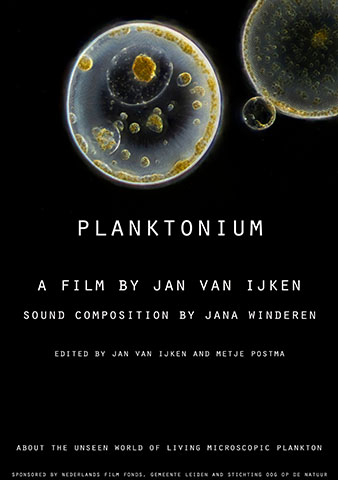
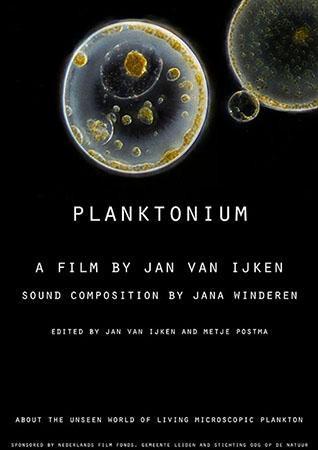
Planktonium is a short film about the unseen world of living microscopic plankton. It is a voyage into a secret universe, inhabited by alien-like creatures. These stunningly beautiful, very diverse and numerous organisms are unknown to most of us because they are invisible to the naked eye. However, they are wandering beneath the surface of all waters around us and they are of vital importance for all life on earth.
Jan van IJken filmed the plankton through his microscopes, revealing the beauty and delicate structures of the minute organisms in the finest detail. The film is without any voice-over or explanation.
Renowned Norwegian artist Jana Winderen made a sound composition for the film. She is recording audio environments and creatures which are hard for humans to access, both physically and aurally – deep under water, inside ice or in frequency ranges inaudible to the human ear.
Phytoplankton (small plant-like cells) are producing half of all oxygen on earth by photosynthesis, like plants and trees do on land. Zooplankton (animal-like critters) are eating the phytoplankton, and are on the menu of larger animals in the water. So plankton is forming the base of the food chain of aquatic life. Plankton are also playing an important part in the global carbon cycle. The plankton are threatened by climate change, global warming and acidification of the oceans.
Filmed, directed and produced by Jan van IJken Sound composition by Jana Winderen Edited by Jan van IJken and Metje Postma
Produced with generous financial support of Gemeente Leiden, Stichting Oog op de Natuur and The Netherlands Film Fund.
The Dutch Museum De Lakenhal in Leiden acquired one copy of the short film Planktonium for its collection and the film has been part of Leiden European City of Science 2022 program.
The film received the J. B. CZECZ AWARD FOR BEST CINEMATOGRAPHY at Włodzimierz Puchalski International Nature Film Festival, Łódź, PL 2022
In 2024, I was invited to take part in an epic journey to film plankton at the North Pole onboard of the luxury icebreaker Le Commandant Charcot for National Geographic’s Pole to Pole series with Will Smith and Allison Fong.
In these live performances, I am screening plankton videos, improvising with musicians and sound artists.
2025 Inscience Film Festival, Nijmegen, NL (2 performances, with John van Oostrum) 2025 Mu Hybrid Art House, Eindhoven, NL (with John van Oostrum) 2024 IDFA on Stage, Eye Filmmuseum Cinema 1 (with Jana Winderen) 2024 Kunstroute, Auditorium Museum De Lakenhal (with John van Oostrum) 2024 Glastonbury Festival, Tree Stage, UK (with Steve Everitt / Entity) 2024 International Film Festival Rotterdam, Art Directions program, Worm, NL (with Vitja Pauwels) 2023 ‘O’ / Videodroom for Viernulvier & Film Fest Gent, De Vooruit, Gent, BE (with musicians Naima Joris, Niels van Heertum and Vitja Pauwels)
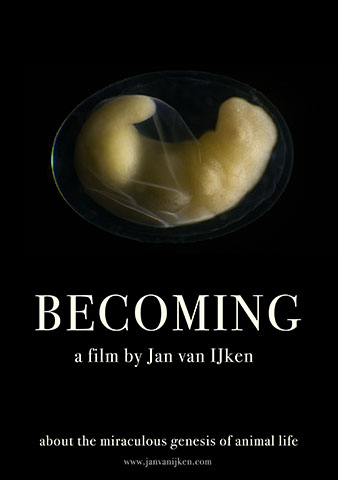
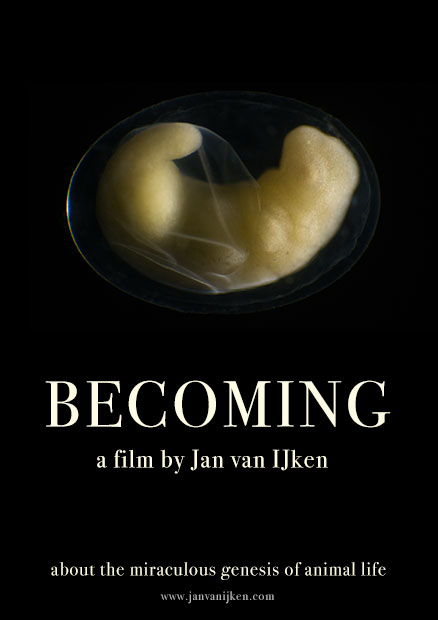
Becoming is short film by Jan van IJken about the embryology of a salamander. In this film we witness the ‘making of’ a salamander in its transparent egg from fertilization to hatching, filmed in great microscopic detail.
The first stages of embryonic development are roughly the same for all animals, including humans. In the film, we can observe a universal process which normally is invisible: the miraculous genesis of animal life. A single cell is transformed into a complete, complex living organism with a beating heart and running bloodstream.
The salamander embryo (an Ichthyosaura Alpestris) was followed very closely in a combination of timelapse and film. All stages of embryogenesis can be seen in this film: cleavage, gastrulation, neurulation and organogenesis. Time was condensed from about 3 weeks to 6 minutes.
2018, HD video, color, 06:15
SCREENINGS AND AWARDS
Becoming has been screened at more than 25 international film festivals and received the Award for best short documentary at the Innsbruck nature film festival 2018, the Visual Science Award at Imagine Science Abu Dhabi 2019 and a honorary mention at Academia Film, Olomouc, CZ. The film was awarded Vimeo Staff Pick of the Month and was nominated for Vimeo Best of 2019 (top 10 experimental films).
In 2019 the film went ‘viral’ on internet and has been watched by millions of people. It was published on the website of National Geographic (13 million views and counting), Aeon, Colossal, Live Science, IFLScience and numerous others. The Dutch TV show De Wereld Draait Door screened the film, including an interview.
Acknowledgements; Many thanks to: Alex Kenter salamander breeder with endless patience in providing eggs. Ben Geutskens for sharing his knowledge about the biology and life cycles of salamanders: http://www.semperinmotus.nl/ My friends at the Dutch microscopy club NGVM: http://www.ngvm.nl Huibert Boon for the audimix and foley http://www.boonbooy.nl/
Jan van IJken is a filmmaker and photographer from the Netherlands, working at the interface of art and science. His work is about the secrets of nature, microscopy, embryology and human-animal relationships.
Planktonium – Short film
about the unseen world of microscopic plankton
Planktonium – Photobook
Available in English and German
Becoming
Short film about the miraculous genesis of animal life
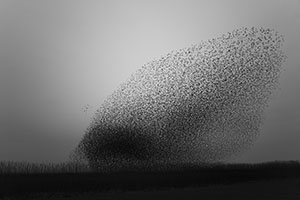
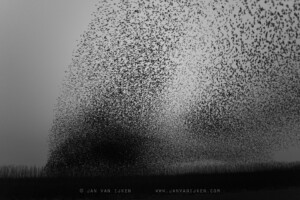
The art of flying
Film about starling murmurations
Nevermore
Film about the process of action painting
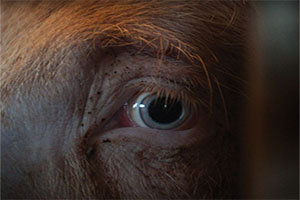
Facing Animals
Film about man and animal
Precious Animals
Photo project about the relationship between man and animal
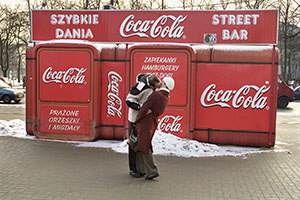
New Neighbours
Photo project about twin cities in Netherlands and Eastern Europe
Jan van IJken is a filmmaker and photographer in Leiden, the Netherlands, working on the interface of art and science. In his latest works, he reveals secrets in nature like the murmurations of starlings, the genesis of life and the unseen world of microscopic plankton. He is interested in microscopy, nature, biology, evolution, and embryology. His award-winning work has been published in numerous international media, e.g. National Geographic and BBC Planet Earth III.
In earlier years he published three photobooks on social-documentary subjects like devotion in Eastern Europe and the relationship of man and animal. He developed a keen eye for light and composition and specializes on autonomous long-term projects.
Projects
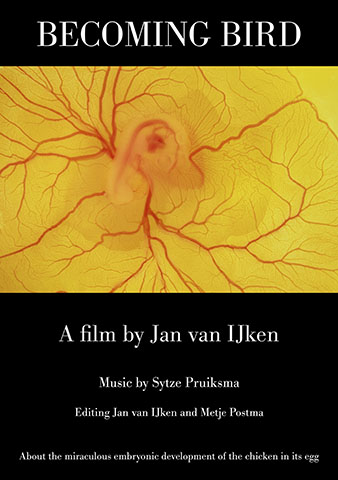
Becoming Bird (2026, 4K, color, 09:20)
Becoming Bird is a short film about the miraculous embryonic development of a chicken inside its egg, from fertilized egg cell to hatching. In the film, we observe the developing embryo in remarkable detail: the appearance of veins carrying streaming blood and a beating heart, the development of the brain, eyes and other organs, the embryo’s first movements, the emergence of feathers, and finally the hatching of the chick. It is an emotional journey, filmed by Jan van IJken with extraordinary precision and detail.
Planktonium – short film (2021, 4K Video, color, 15:23) and photobook
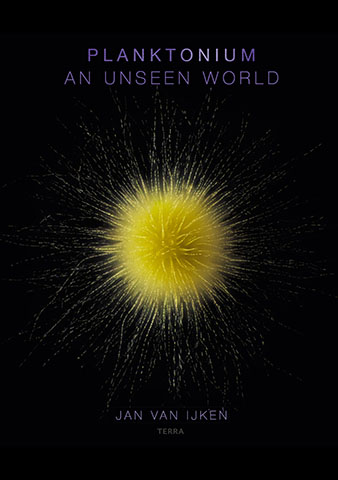
Planktonium is a short film and photobook about the unseen world of living microscopic plankton. The film includes a sound composition by Jana Winderen. It is a voyage into a secret universe, inhabited by alien-like creatures
Planktonium had its world premiere at Ji.hlava Documentary Film Festival, CZ and was screened at many international film festivals and art galleries.
The Dutch Museum De Lakenhal in Leiden acquired one copy of the short film Planktonium for its collection and the film has been part of Leiden European City of Science 2022 program.
The film received the J. B. CZECZ AWARD FOR BEST CINEMATOGRAPHY at Włodzimierz Puchalski International Nature Film Festival, Łódź, PL 2022
In 2024, I was invited to take part in an epic journey to film plankton at the North Pole onboard of the luxury icebreaker Le Commandant Charcot for National Geographic’s Pole to Pole series with Will Smith and Allison Fong.
In these live performances, I am screening plankton videos, improvising with musicians and sound artists.
2025 Inscience Film Festival, Nijmegen, NL (2 performances, with John van Oostrum) 2025 Mu Hybrid Art House, Eindhoven, NL (with John van Oostrum) 2024 IDFA on Stage, Eye Filmmuseum Cinema 1 (with Jana Winderen) 2024 Kunstroute, Auditorium Museum De Lakenhal (with John van Oostrum) 2024 Glastonbury Festival, Tree Stage, UK (with Steve Everitt / Entity) 2024 International Film Festival Rotterdam, Art Directions program, Worm, NL (with Vitja Pauwels) 2023 ‘O’ / Videodroom for Viernulvier & Film Fest Gent, De Vooruit, Gent, BE (with musicians Naima Joris, Niels van Heertum and Vitja Pauwels)
Six photos were nominated for a Wildscreen Panda Award 2022, category Photo Story, and in the Nikon Small World competition two photos were awarded 9th place / honourable mention, plus one honourable mention for a videoclip from Planktonium.
The photo series was published in National Geographic Magazine NL, New Scientist, Oceanographic Magazine, NRC Handelsblad, Algemeen Dagblad, Süddeutsche Zeitung among many others.
Radio and TV interviews by Vroege Vogels and M in the Netherlands
Becoming– short film (2018, HD Video, color, 06:15)
BECOMING is a short film about the miraculous genesis of animal life. In great microscopic detail, we see the ‘making of’ a salamander in its transparent egg from fertilization to hatching.
Becoming has been screened at more than 25 international film festivals and received the Award for best short documentary at the Innsbruck nature film festival 2018, the Visual Science Award at Imagine Science Abu Dhabi 2019 and a honorary mention at Academia Film, Olomouc, CZ. The film was awarded Vimeo Staff Pick of the Month and was nominated for Vimeo Best of 2019 (top 10 experimental films).
In 2019 the film went ‘viral’ on internet and has been watched by millions of people. It was published on the website of National Geographic, Aeon, Colossal, Live Science, IFLScience and numerous others. The Dutch TV show De Wereld Draait Door screened the film, including an interview.
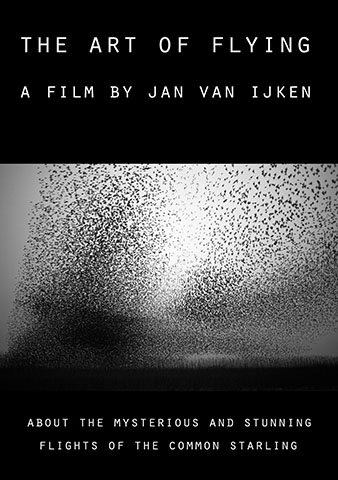
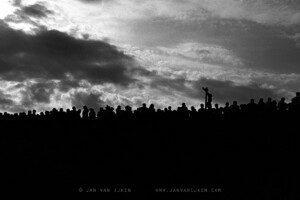
The art of flying –short film (2015, HD Video, black&white, 06:52) and photo series
Short film about “murmurations”: the mysterious flights of the Common Starling
The film has been screened at more than 50 international film festivals, galleries, biennales, etc. and was awarded ‘Best art film’ at Pärnu Film Festival, Estonia, selected for National Geographic Short Film showcase and awarded a Vimeo Staff Pick.
Nevermore – short film(2013 HD Video, color, 03:37)
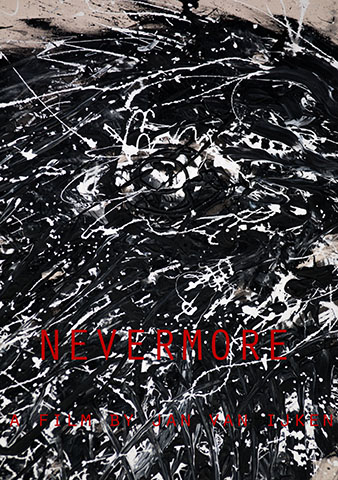
Film about the fast and almost instinctive creative process of action painting by dribbling, splashing, scratching and smearing paint on a huge canvas. The work is based on the poem ‘The Raven’ by Edgar Allan Poe: an almost abstract chaos of words and sounds.
Jan van IJken filmed Dutch artist Theo Zwinderman painting ‘The Raven’ and edited the film on the rhythm of a reading of the poem by George Snow.
Facing Animals– short film (2012, HD Video, color, 29:31)
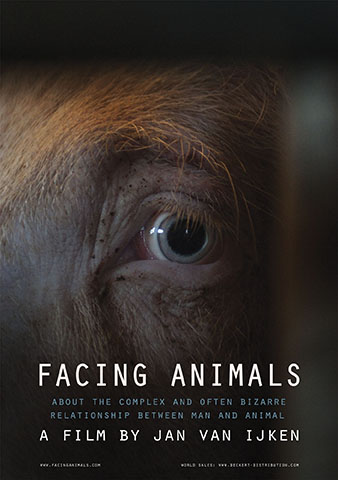
Facing Animals (debut film of Jan van IJken) is a documentary film about the complex and often bizarre relationship between man and animal.
Why do we look away from millions of animals in industrial farms while pampering and humanizing others? In the film Facing Animals pigs, chickens, cows and dogs are the protagonists, humans are the antagonist.
Grand prix short films at Split Film festival, Croatia and screenings at international film festivals.
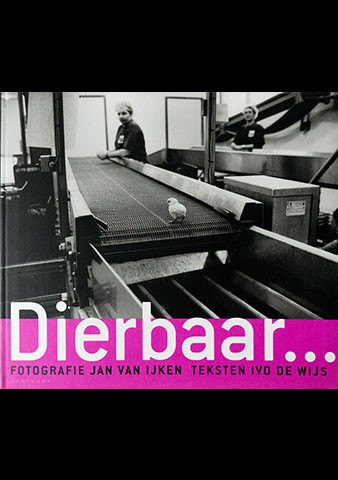
Dierbaar (Precious animals) – photobook (2005) about the relationship between man and animal
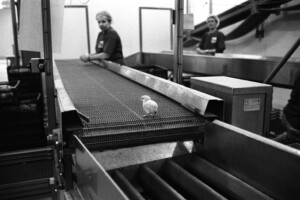
Precious Animals (2005) is a photo-project about the relationship between animals and humans, focusing on animals as manufactured consumer products on the one hand, with efficiency playing the leading role, and these very consumers and their habit of pampering their own pets and other cuddly two and four-legged creatures, on the other hand.
Precious Animals was commissioned by the Rijksmuseum and NRC Handelsblad as part of their series ‘Document Nederland’. The photos were exhibited in photo museum Huis Marseille, Amsterdam from Nov 2005 – Feb 2006, along with a special supplement of NRC Handelsblad and the publication of the photobook Dierbaar.
The series was published in many international newspapers and magazines (e.g. De Morgen, Frankfurter Allgemeine Sonntagszeitung, El Mundo Magazine, Eight, Mother Jones Magazine and Days Japan) and received a Humanity Photo Award, an International Photography Award and was selected for American Photography. The series was screened at photo festival Visa pour l’image, Perpignan, France
Awards: Humanity Photo Award, China, 3rd prize Daily Life 2006, International Photography Awards, 3rd prize Photo Essays 2006, Black and White Spider Awards, Nomination Fine Arts 2007
Collections: Rijksmuseum Amsterdam, John Cleary Gallery Houston USA, Museum of Fine Arts Houston USA
Radio interviews (Dutch only): Vroege Vogels, 2 hour special / interview 2005 and Kunststof Radio, 1 hour interview 2005:
Interview Kunststof radio (in Dutch) 15 November 2005
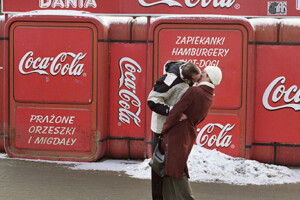
New Neighbours – photobook (2004) about the enlargement of the E.U.
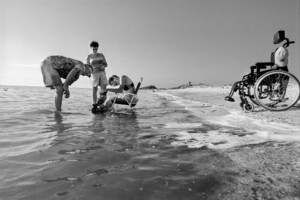
Photo-project about daily life in five Eastern European and five Dutch municipalities. Van IJken has used the twinning of these municipalities as a starting point from which to compare everyday life in Eastern and Western Europe. People are the focus of this series of photos. The individuals who inhabit these images have been captured in all kinds of everyday situations.
The series was published in the photobook ‘New Neighbours’ (2004) and was exhibited in the Atrium, The Hague, The Netherlands
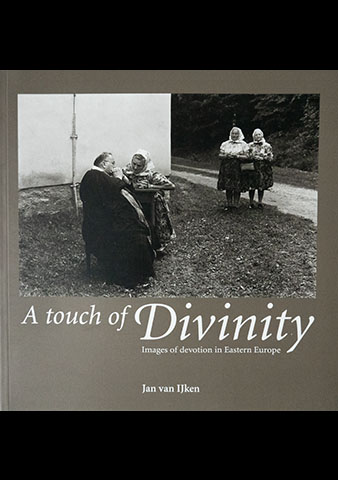
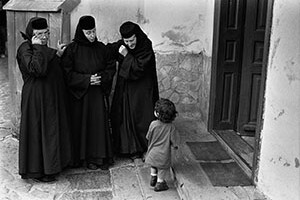
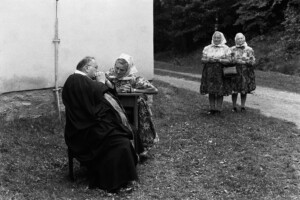
A touch of Divinity– photobook (2001) about religion in Eastern Europe
From 1997 to 2000 Jan van IJken worked on a photo project about religiosity in Eastern Europe. Travelling through Poland, the Ukraine, Slovakia and Rumania, he was present at pilgrimages, religious festivals, liturgies and processions.
The photos were published in the photobook ‘A touch of Divinity’ (2001) and were exhibited in a travelling exhibition in monumental churches in the Netherlands.
The publication of the book was followed by travelling exhibition in monumental churches in the Netherlands. The project received a Humanity Photo Award, China, 2nd prize Daily Life in 2002